
Community Engagement Toolkit
Who is this toolkit for?
This toolkit is for anyone with an interest in community engagement as part of their role. The structure of this toolkit is based on the Engagement Cycle. The toolkit can be used as a step-by-step guide, or you can skip to the section most relevant to what you need to find out about.
To use the toolkit, please click on each circle for tips and advice at each stage.
Community Engagement Toolkit

Engagement Cycle
Identify the Issue
There are lots of situations that might require engagement to take place with people who use your services or local communities including:
- Developing priorities or identifying key areas of focus
- Building an evidence base to apply for funding
- Research and evidence for a project
- To better understand people’s “lived experience”
- Building and developing ongoing relationships and dialogue
- Real-time service improvement
- Service change or a redesign
Top tips:
- Agree a clear purpose to identify engagement objectives, anticipate outcomes, and to help determine the scope of the engagement.
- There should be clarity and a shared understanding of the objectives at the outset to help shape the process and identify the best methods to reach people and communities.
- Project goals may evolve as engagement progresses, but they are necessary to keep the process focused.
Some engagement, particularly if undertaken by a public body comes with a legal obligation and specific guidance.

Community Empowerment Act (Scotland) Act 2015
Aims to empower communities by strengthening their voices in decisions about public services and making it easier for them to own and manage land and buildings. It also places a legal requirement for public bodies and local agencies to involve communities in all stages of planning.

Rights of Children and Young People
The Scottish Government is committed to Scotland being the best place in the world to grow up. A central part of this vision is the recognition of, respect for, and promotion of children’s rights. These include rights to be treated fairly, to be heard and to be as healthy as possible. This vision requires children’s rights to be embedded in all aspects of society, where policy, law, and decision-making take account of children’s rights and where all children have a voice.

Service Change
NHS boards have a statutory duty to involve people in designing, developing and delivering healthcare services. Healthcare Improvement Scotland has developed a range of resources to help when undertaking a service change.
Planning with People
Published by the Scottish Government and COSLA, sets out expectations for NHS boards, Integration Joint Boards and councils, that are planning and commissioning care services in Scotland.
What is Service Change?
This short video from Healthcare Improvement Scotland explains things you may want to consider if undertaking engagement from a health and social care organisation.
Identify Stakeholders
(Who needs to be involved)
Identifying the people with whom you want to engage is a really important early step. Who to involve will depend on your engagement aims and objectives.
Stakeholder mapping can be a really useful way of identifying the people who should be involved in the engagement. Where possible, it is helpful to do this with people who are important to your project.
Understanding who and how many people will be affected by the work you are undertaking will help to inform the reach of the engagement.
Useful resources
Communication and engagement plan
A communication and engagement plan will help you to identify who you need to engage with as part of your work and how and when you will do this

A Local Information System for Scotland (ALISS)
ALISS can help you find community groups, organisations and services by location and area of interest (for example mental wellbeing).

Data and research
can help you understand the communities you are working with in more depth.

Directory of Community Groups
This resource has been developed by Aberdeen Equalities Participation Network, to improve engagement with equality-related groups and organisations in the City. Groups are listed by characteristic and may be listed in two or three categories if relevant.

Stakeholder analysis list (DOCX)
Helps you to think about everyone who may have an interest in the engagement.
Level of interest and influence matrix (DOCX)
Helps you understand people’s level of interest and influence in the engagement.
To ensure you meet the needs, issues and aspirations of the people you are engaging with, you should consider the following:
Who are you trying to engage?
- Literacy requirements. What styles/types of communication would best support maximum participation? The RNIB has produced some helpful guidance for blind or partially sighted people.
- A loop system and/or signer.
- ESOL (English Speakers of Other Languages) support.
- Locally accessible venues at appropriate times.
- Marketing. Think about marketing and seek advice from a relevant team, organisation or contacts.
- Appropriate language. Avoid abbreviations and jargon or include a jargon buster.
- Timescales. Giving people enough notice to respond/ attend but not too much in advance that they may forget.
- Being mindful of childcare, dependent care and work commitments.
- Payment/reward for people’s time and reimbursement of expenses (for example travel).
Common Barriers to Engagement
This video clip explains the importance of ensuring your engagement is inclusive and considers the needs of people who you would like to involve in the process.

The Lundy flowchart
Check if you need to engage with children and young people by following the Lundy flowchart

Let’s have a chat…on our terms
Hear from young people about how they want to be engaged with, through ‘Let’s have a chat…on our terms’ created by Granite City Speaks with help from the Reboot project.

CEG creating young person friendly information
Use child and young people friendly communication, see our learning from our Child Rights project
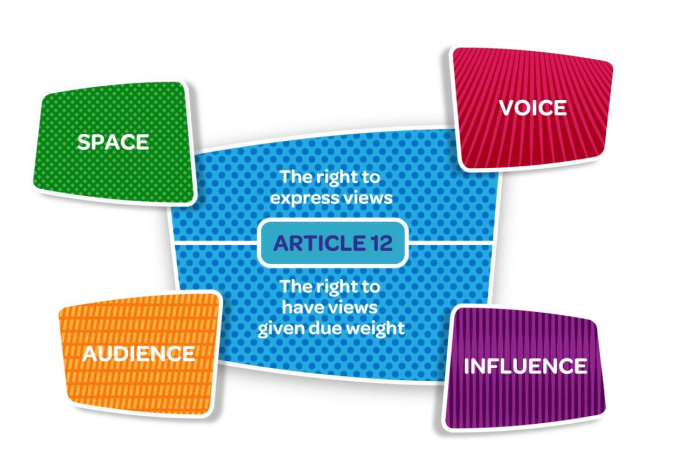
The Lundy model of child participation
Provides a structure for engaging with children and young people, ensuring that the areas of space, voice, audience, and influence are considered and actioned.

Create Meaningful Participation
Create Meaningful Participation and Engagement of Children and Young People Children in Scotland’s Principles and Guidelines, this provides ideas for planning, delivery and keeping children safe.
Undertaking an Equality Impact Assessment (EQIA) can be an important early step in understanding who you should be considering as part of any engagement. An EQIA enables equality and human rights to be embedded in policies, practices and priorities of public bodies in Scotland.
Directory of Community Groups
This resource has been developed by the Aberdeen Equalities Participation Network, to improve engagement with equality-related groups and organisations in the City. Groups are listed by characteristic and may be listed in two or three categories if relevant.
You can speak to your organisation’s equality, inclusion and diversity lead for further guidance should you need it.
Impact Assessments
This video clip explains the importance of carrying out an impact assessment when working in a health and social care setting.
Plan the Engagement
Identifying the best approaches to reach the people is vital.
Involving community representatives at an early stage will help to encourage the flow of ideas and suggestions. This should result in better engagement and outcomes.
To support the planning and delivery of community engagement activities, a useful resource is the Visioning Outcomes in Community Engagement (VOiCE) planning software.
VOiCE is based on the National Standards for Community Engagement. This should help ensure that you get the most out of your project.
VOiCE helps you work through each step of an engagement exercise including:
- Planning community engagement participation.
- Monitoring and recording the process.
- Evaluating the process against the National Standards for Community Engagement (Scotland) and principles for good quality engagement.
VOiCE is free to use for anyone. You will need to register for an account in order to use the software.
Paper versions of the VOiCE planning tool and tutorials are available from the VOiCE website.

The Place Standard Tool
The Place Standard tool provides a simple framework to structure conversations about place. It allows you to think about the physical elements of a place (for example its buildings, spaces, and transport links) as well as the social aspects (for example whether people feel they have a say in decision making).

The Scottish Coproduction Network
Hosts a wide range of information, including bespoke guidance for a range of engagement scenarios, including community-based, health and social care, families, children and young people.

Asset Based Community Development (ABCD)
Asset Based Community Development’s premise is that communities can drive the development process themselves by identifying and mobilising existing, but often unrecognised assets. Thereby responding to challenges and creating local social improvement and economic development.

The Community Paradigm
The Community Paradigm sets out the case for a fundamental shift in how public services work – to share power with people rather than hoard it. This approach is building a movement of practitioners and policymakers who see this shift as increasingly urgent.
Scottish Approach to Service Design
Is an approach to understanding and redesigning services. It considers the needs of those interacting with and using the service employees and processes that help that service run.

A Trauma Informed Approach
A Trauma Informed Approach means being able to recognise when someone may be affected by trauma, collaboratively adjusting how we work to take this into account and responding in a way that supports recovery, does no harm and recognises and supports people’s resilience.
This video clip highlights how to support effective engagement in health and social care settings.
Engage
(What methods can you use to involve people)?
Choosing an engagement method, or combination of methods, for engaging both digitally and/or in person, is a critical step in the planning process.

The Healthcare Improvement Scotland Participation Toolkit
Suggests a wide range of tools, guidance and resources which can be useful for engaging with people.

Involve Methods
Involve has a wide range of resources to support with community engagement methods.
Evaluating your engagement
(How to measure and understand impact)
It is important to carry out evaluation throughout the engagement process to ensure that outcomes set at the beginning are being met.
Ongoing evaluation also demonstrates that people are being listened to by adapting the approach where appropriate.
Evaluation can also identify areas for improvement and will help you understand what works and what doesn’t.
All information gathered from the engagement process should be captured and evaluated to support future learning.
The key to successful evaluation is to evaluate progress and act on lessons that emerge during the engagement process.
Undertaking an Equality Impact Assessment (EQIA) can be an important early step in understanding who you should be considering as part of any engagement. An EQIA enables equality and human rights to be embedded in policies, practices and priorities of public bodies in Scotland.

Evaluation Support Scotland
Provides a range of resources to help with measuring and explaining the impact.

Visioning Outcomes in Community Engagement (VOiCE) software
Can be used to evaluate the engagement process against the National Standards for Community Engagement (Scotland).
You can speak to your organisation’s equality, inclusion and diversity lead for further guidance should you need it.
Key evaluation considerations
- Did you meet your objectives?
- Did you reach all the people you needed to reach?
- Did you develop knowledge of communities and gather useful data?
This video clip explains the importance of evaluating your engagement project and the key things to consider.
Feedback and decision-making
It is important to keep participants up to date and informed about the engagement process as it develops.
When decisions are reached, speedy information sharing should be provided as a priority explaining the impact of community engagement on the outcome.
It is important to welcome critical challenges and respond to them by demonstrating a willingness to answer questions openly and to consider adapting plans according to emerging evidence.
Organisations must explain clearly the rationale for decision-making and the impact this has had on the outcome. Transparency is essential to generate trust.
The feedback stage is of vital importance in maintaining confidence and trust in the integrity of the involvement process.
Stakeholders who take part in engagement must be given feedback to:
- Inform them of the outcome of the engagement process and the final agreed development or change.
- Provide a full and open explanation of how views were taken into account in arriving at the final decision.
- Provide reasons for not accepting any widely expressed views.
Privacy and confidentiality must always be observed. Reporting and feedback must be anonymised unless consent has been given by individuals to publish or release their personal information.
Closing the ‘engagement’ loop is the step in the engagement cycle which is often overlooked due to limitations of staff time or opportunity.
After collecting feedback organisations can be tempted to go straight to the ‘implementation stage’ without following up with people they have engaged with to demonstrate how their input may have impacted the final outcomes.
This can be harmful as people may be less likely to give feedback in the future as they feel they have not been listened to, and contribute towards a sense of ‘engagement fatigue’
The Parable of the Blobs and the Squares
This video clip highlights the benefits of involving people at all stages of your engagement project.
Community engagement is a way of developing a working relationship between public bodies (for example, local councils) and community organisations. It is also a way in which other organisations like community groups, voluntary sector groups and the private sector can better involve people in what they do.
Good community engagement will mean that both groups can understand and act on the needs or issues of community experiences.
It involves respectful dialogue between everyone involved, aimed at improving understanding between communities and organisations, helping them to take joint action to achieve positive change.
This video clip explains more about community engagement.
National Standards for Community Engagement are good-practice principles designed to improve and guide the process of community engagement. It can be helpful to think about each standard when planning your community engagement.

There are 7 Standards:
- Inclusion
- Support
- Planning
- Working together
- Methods
- Communication
- Impact
The Grampian Engagement Network (GEN) has identified 10 standards for good quality engagement through their Charter for Community Engagement which supports organisations to put the Community Empowerment (Scotland) Act into practice.
The Grampian Engagement Standards are based on best practice guidance from the National Standards of Community Engagement, Scottish Approach to Service Design, Quality Improvement and Planning with People.

The Grampian Engagement Standards are:
- Planning
- Identifying and appreciating resources
- Being inclusive
- Fostering ownership
- Building on previous engagements
- Being aspirational
- Working and learning together
- Building trust and relationships
- Making engagement a worthwhile experience for participants
- Closing the loop

The “Putting People First” initiative
The “Putting People First” initiative by NHS Grampian aims to enhance community engagement and improve health services in the Grampian area. This approach focuses on collaboration with colleagues and citizens, inviting them to contribute to shaping the future of health and care. It emphasizes listening to the local community and involves a commitment to systemic change in how services are delivered. The initiative is endorsed by the NHS Grampian board and aims to create equal partnerships with the public, guided by principles of collaboration and shared purpose.